
Too many room types can quietly slow down a hotel project. One small layout change can affect drawings, structure, plumbing, furniture, inspections, and brand review.
Every unnecessary variation can add cost. Repeatability helps developers reduce that drag before it starts.
Repetition Reduces Coordination
Fewer room types make a project easier to coordinate. When layouts and details repeat, teams have fewer one-off conditions to solve.
That difference becomes clearer when you compare a project with many room variations against one built around repeated room modules.
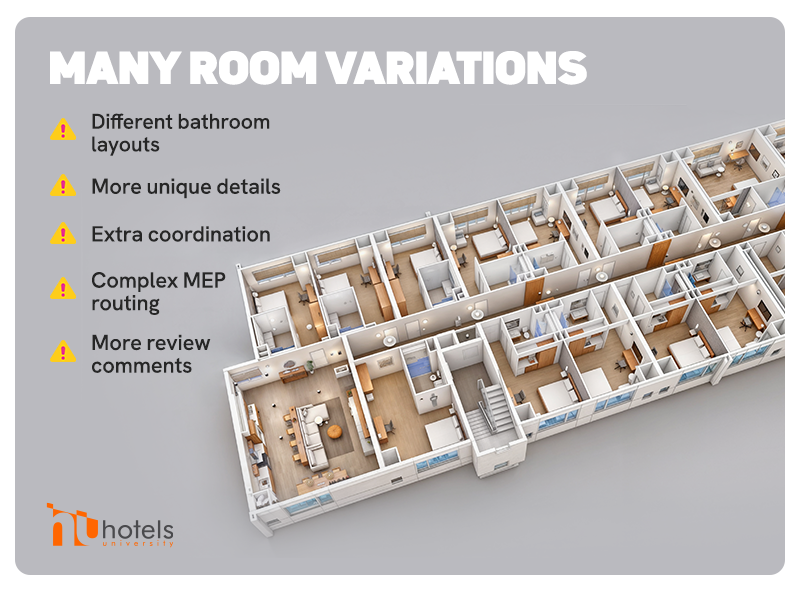
More variation can lead to:
-
More complexity
-
More review time
-
Higher cost risk
-
More field risk
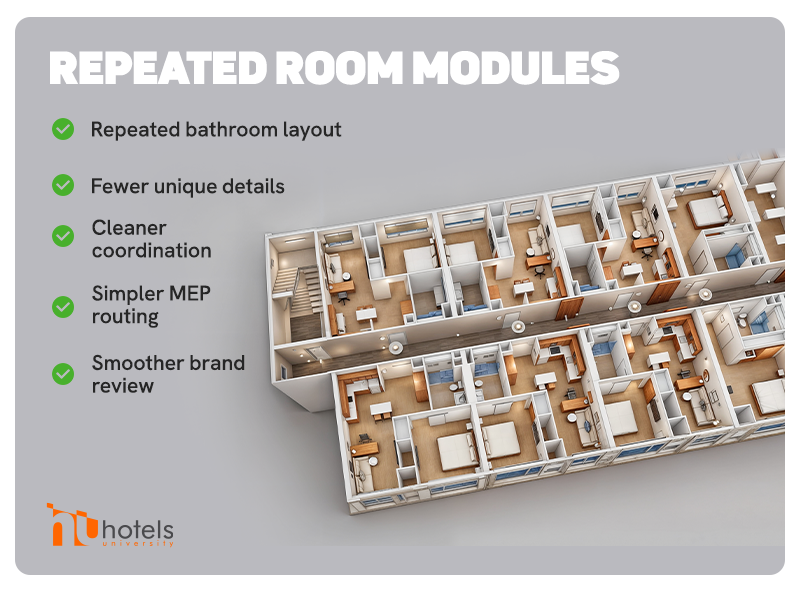
More repetition can support:
-
Less complexity
-
Less review time
-
Lower cost risk
-
Fewer field surprises
Repeat the Technical. Customize the Experience.
Standardizing bathrooms, plumbing walls, shafts, and key details can simplify MEP coordination, brand review, and construction. Finishes, lighting, art, and casegoods can still create a distinct guest experience.
BASE4 Designs Repeatability Early
BASE4 helps hotel developers make room planning decisions early, before small variations become expensive coordination problems.
Why developers work with BASE4:
- In-house architecture, structural, MEP, interiors, and visualization
- 100% Revit and 3D coordination
- Hotel brand experience across major flags
- Early planning that reduces late-stage redesign
- Cost-aware design for developers and GCs
- Prefab and offsite design expertise
If your next hotel project is still in early planning, now is the right time to talk room mix.
Thank you,
Blair Hildahl
Blair@hotelsuniversity.com
608.304.5228